

In this article
A US CPA firm charges $65–$150/hr for routine bookkeeping. A Filipino bookkeeper via FilAm charges $6–$14/hr for the same tasks - QuickBooks, bank recs, month-end close - with a BS Accountancy degree and US GAAP training. The annual cost difference: $28,000–$56,000 per bookkeeping FTE.
The Three Options for US Business Bookkeeping
Every US small business owner running books has three real options. The right one depends on transaction volume, complexity, and how much of your accounting workflow you want to manage directly.
Option 1: US employee bookkeeper. A full-time hire on your payroll. Salary range $45,000–$70,000 plus benefits and taxes - total fully loaded cost $58,000–$90,000/yr. You manage them directly, control all workflow, and own the relationship.
Option 2: US CPA firm bookkeeping service. Outsourced to a US-based firm at $65–$150/hr depending on tier and city. No employer obligations. You hand off transactions; they reconcile. Common for businesses doing $1M–$10M revenue who need clean books but don't have volume to justify a full-time hire.
Option 3: Filipino bookkeeper via FilAm. A dedicated remote professional at $6–$14/hr ($960–$2,240/mo full-time). Same software (QuickBooks, Xero), same standards (US GAAP), same monthly close cycle. FilAm handles vetting, contracts, and compliance. You manage outcomes.
The Full Cost Comparison
| Option | Hourly | Annual (40hr/wk) | What's Included |
|---|---|---|---|
| US Employee Bookkeeper | $22–$35 | $58,000–$90,000 fully loaded | Salary + FICA + benefits + PTO + recruiting |
| US CPA Firm Service | $65–$150 | $32,000–$78,000 (typical retainer) | Hourly billing, monthly close, basic reporting |
| FilAm Filipino Bookkeeper | $6–$14 | $12,000–$29,000 all-in | Dedicated FTE, vetted, contracts + compliance handled |
For a small business needing 20–40 hours per week of bookkeeping work, the math separates fast: a US CPA firm at 20 hours/week and $95/hr blended rate runs $98,800/yr. A FilAm senior bookkeeper at 40 hours/week and $12/hr runs $24,960/yr - covering double the hours at one-quarter the cost.
What "Same Quality" Actually Means
The quality question is fair, and the honest answer requires specifics. Three structural facts about Philippine bookkeeping credentials:
- 250,000+ licensed CPAs. The Philippines has one of the highest per-capita CPA densities in Asia. The CPA Philippines exam is rigorous and respected by international employers.
- BS Accountancy is the standard degree. 85% of FilAm bookkeeping specialists hold a BS Accountancy degree from a CHED-accredited Philippine university - the same accreditation standard as a US accounting degree.
- QuickBooks ProAdvisor and Xero Advisor certifications are common. Both are international credentials verified directly by Intuit and Xero. A FilAm-vetted bookkeeper with these credentials has met the same standard as a US bookkeeper with the same certifications.
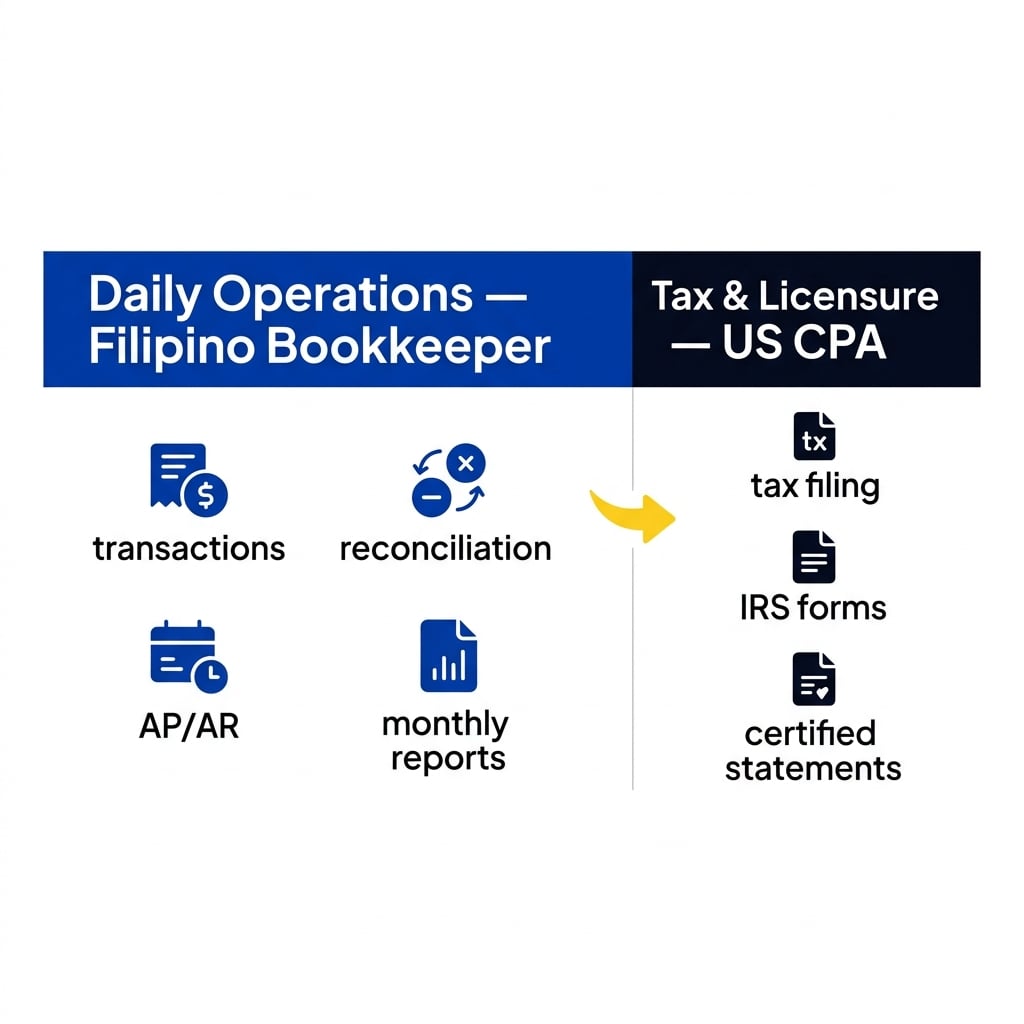
What you don't get without a US CPA: tax filing, IRS representation, certified audit opinions, or anything requiring US-licensed professional sign-off. Those remain with your US CPA. The split: Filipino bookkeeper handles 90% of the daily work - categorization, reconciliation, reporting, AP/AR, month-end close. US CPA handles the 10% that requires US licensure. Both win on cost.
When You Still Need a US CPA - And When You Don't
You still need a US CPA for:
- Filing federal and state tax returns (1120, 1120-S, 1065, 1040)
- Representing your business before the IRS in audits or correspondence
- Issuing certified financial statements (audit, review, compilation opinions)
- Year-end tax planning and quarterly estimated tax projections
- Complex transactions: M&A, ownership changes, multi-state nexus questions
You don't need a US CPA for:
- Daily transaction entry and categorization
- Bank and credit card reconciliation
- Accounts payable and receivable processing
- Month-end close and P&L generation
- Payroll processing coordination (with US-licensed signoff)
- 1099 preparation and contractor payment tracking
- Chart of accounts maintenance
The optimal split for most US small businesses: a Filipino bookkeeper handling the operational 90%, a US CPA handling the licensed 10%. Annual savings vs. running everything through the US CPA firm: $40,000–$70,000.
How to Transition Your Bookkeeping from a US CPA Firm to a Filipino Professional
- Map your current monthly close process. Document what your US CPA firm does each month - what reports they produce, what their reconciliation method looks like, what categorization rules they follow. This becomes the runbook for your Filipino bookkeeper.
- Post the role on FilAm. Specify QuickBooks or Xero proficiency, US GAAP requirement, prior US client experience, and your transaction volume. FilAm shortlists pre-vetted candidates after review.
- Run a 30-day parallel period. Have the Filipino bookkeeper reconcile the previous month alongside your US CPA's output. Compare results. Resolve any categorization differences. By day 30, you've validated competence without risk.
- Cut over to Filipino bookkeeper for daily operations. They handle daily and monthly work. Your US CPA reviews quarterly and handles tax season.
- Quarterly CPA review becomes the audit point. Your US CPA reviews the books once per quarter, catches anything that needs correction, and signs off on the data going into tax filings.
Common Questions
Can a Filipino bookkeeper communicate with my US CPA?
Yes. Filipino bookkeepers vetted through FilAm work directly with US CPAs as a standard part of the engagement. They prepare CPA handoff packages, answer reconciliation questions, and coordinate on tax-season preparation. Most US CPAs find the relationship efficient - they're talking to someone who's already done 90% of the work.
What if my US CPA isn't comfortable with a Filipino bookkeeper?
Some CPAs prefer working with US-based staff because of familiarity, not because of competence concerns. A 30-day parallel period typically resolves this - once the CPA sees the quality of work product, the relationship normalizes. If your CPA refuses to work with offshore staff after seeing the output, that may be a signal to reconsider the CPA, not the bookkeeper.
Is my financial data secure offshore?
Yes, when structured correctly. Grant accountant-level access in QuickBooks or Xero (read/write, not admin). Use a secured Google Drive or 1Password vault for document sharing. All FilAm bookkeepers sign confidentiality agreements before engagement. The data security architecture is identical to working with any remote US employee.
See FilAm's bookkeeper role page for current availability, or read the full vetting guide before posting your role.
Ready to find your match?
FilAm matches you with vetted Filipino professionals. From $5.85/hr.


