

In this article
A Filipino bookkeeper through FilAm costs $6–$14/hr ($960–$2,240/mo full-time), depending on seniority and software expertise. The Philippines has over 250,000 licensed CPAs, and most FilAm bookkeepers hold a BS Accountancy degree and are certified in QuickBooks or Xero. Standard US GAAP training is included in the vetting process.
Why US Founders Hire Filipino Bookkeepers - And Why Some Get Burned
The cost case is obvious: a US bookkeeper costs $65,000/yr fully loaded. A Filipino bookkeeper via FilAm runs $15,000–$25,000/yr. The $40,000–$50,000 annual gap is real, and for most small and mid-sized US businesses, it's the entire difference between a constrained budget and a comfortable one.
But founders who hire the wrong way get burned. The most common failure mode: hiring a Filipino bookkeeper trained on Philippine Accounting Standards (PAS) rather than US GAAP. The reconciliation logic is different. The chart of accounts structure is different. Three months of miscategorized transactions and a panicked CPA call are avoidable - but only if you verify standards before you start.
FilAm's filter for bookkeepers requires: a BS Accountancy degree from a CHED-accredited Philippine university, a live financial accuracy simulation (tested, not self-reported), and US GAAP baseline verification. The structured assessment process applies here as much as anywhere else - most bookkeeper applicants are eliminated during the live simulation.
What Filipino Bookkeepers Can Handle for US Businesses
A FilAm-vetted bookkeeper covers the full operational scope of small-to-mid business financial management:
- Daily bookkeeping entries and general ledger maintenance
- Accounts payable and receivable processing
- Monthly bank and credit card reconciliation
- Weekly and monthly P&L, balance sheet, and cash flow reports
- Payroll processing coordination (ADP, Gusto, QuickBooks Payroll)
- Tax season documentation and CPA handoff packages
- Chart of accounts maintenance and transaction categorization
- Proactive discrepancy flagging and cash flow risk alerts
Common platforms: QuickBooks Online, QuickBooks Desktop, Xero, Wave, FreshBooks, Bill.com, Gusto. Platform proficiency is tested during vetting - not assumed from a resume line.
What they don't do without a US CPA: sign off on tax filings, represent clients before the IRS, or provide certified audit opinions. FilAm bookkeepers are operations-level finance professionals, not licensed CPAs under US law. The right model is a Filipino bookkeeper handling the daily work, with your US CPA reviewing and filing.
Filipino Bookkeeper Rates - 2026 Data
| Level | Hourly Rate | Monthly (FT, 40hr/wk) | Key Skills |
|---|---|---|---|
| Entry | $6.00–$8.00/hr | $960–$1,280/mo | QuickBooks basics, data entry, bank recs |
| Mid-Level | $8.00–$10.00/hr | $1,280–$1,600/mo | Month-end close, AR/AP management, payroll assist |
| Senior / CPA-trained | $10.00–$14.00/hr | $1,600–$2,240/mo | Financial reporting, US GAAP expertise, budgeting, variance analysis |
A comparable US CPA firm bookkeeper runs $25–$50/hr - 3–5x the FilAm senior rate for identical work. Part-time options (20 hours/week) start at $480/month. For founders whose bookkeeping volume doesn't justify a full-time hire, a 20-hour specialist handles everything without quality compromise.
Annual cost · bookkeeper FTE
The 5 Questions to Ask Every Bookkeeper Candidate
Which accounting standards do you work in?
The right answer is US GAAP. Philippine Accounting Standards (PAS) is the local equivalent - but the two diverge in ways that matter for US tax prep, GAAP-compliant reporting, and CPA handoffs. Any experienced Filipino bookkeeper serving US clients knows this distinction and will answer it directly.
Can you show me a reconciliation you've done?
Any competent bookkeeper can produce an anonymized bank reconciliation sample. Ask for it. The structure of the output - categories, formatting, handling of discrepancies - tells you more than any interview question. If they can't produce one, that's your answer.
What software have you used this week?
The answer should name specific platforms: QuickBooks Online, Xero, NetSuite, Bill.com. Vague answers ("I'm experienced with accounting software") are a red flag. Active daily use means shorter ramp time and fewer rookie mistakes in your specific setup.
How do you handle a discrepancy you can't explain?
You're looking for ownership language: "I document the variance with notes on what I've ruled out, flag it immediately to the client with the supporting transaction detail, and we work through it together." Deflection - "I'd have to ask my manager" or "it depends" - signals a passive professional who will absorb problems instead of surfacing them.
What does your client communication look like without prompting?
The answer should describe proactive weekly summaries: what was reconciled, what's outstanding, any anomalies spotted. If they only communicate when asked, you've added a recurring management task, not removed one.
What Certifications Should a Filipino Bookkeeper Have?
Certifications signal investment and baseline competence. For a Filipino bookkeeper serving US clients:
- CPA Philippines - rigorous, respected, signals serious accounting education. Not required for a bookkeeper role but a strong signal for senior hires.
- Xero Advisor Certified - Xero's official certification. Tests platform proficiency and accounting fundamentals.
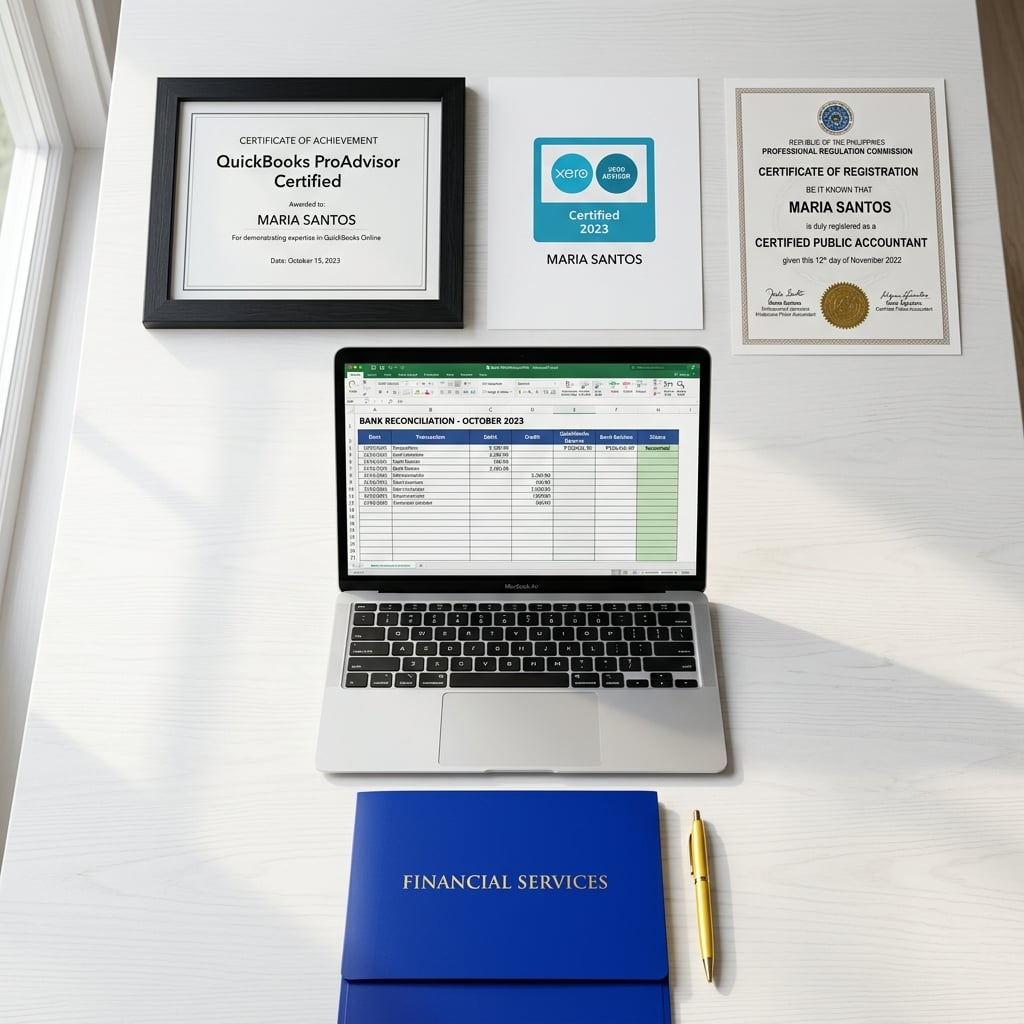
- QuickBooks ProAdvisor - Intuit's certification at Basic, Advanced, and Online levels. Widely held among FilAm-vetted bookkeepers.
- TESDA Bookkeeping NC III - the Philippine Technical Education and Skills Development Authority's national competency certificate for bookkeeping.
85% of FilAm bookkeeping specialists hold a BS Accountancy degree from a CHED-accredited Philippine university - the same standard as a US accounting degree. All certifications are verified before listing. You see credential status on every candidate profile before your first interview.
How FilAm Vets Filipino Bookkeepers
The structured assessment process isn't an arbitrary target - it's the result of a five-stage vetting process most bookkeeper applicants fail:
- Credentials check. BS Accountancy degree and certification verification against issuing institutions. Not self-reported - verified.
- Software proficiency test. Hands-on QuickBooks or Xero simulation. Candidates complete a real dataset, not a multiple-choice quiz.
- Live reconciliation exercise. We provide a bank statement and ledger with two deliberate discrepancies. Candidates must find, explain, and document both. Time-tracked.
- English proficiency oral evaluation. Not just written English - the ability to explain a financial variance clearly on a call or in a Loom video is assessed.
- Cultural fit interview. Ownership mindset, communication style under ambiguity, and experience with US-based client relationships.
Setting Up Your Filipino Bookkeeper for Success
The first 30 days determine whether your bookkeeper runs independently or becomes a recurring management burden. This checklist eliminates the friction:
- Day 1: Grant accountant access in QuickBooks or Xero - no password sharing. Share your chart of accounts and categorization rules in a Notion doc. Record a Loom walkthrough of your current setup.
- Days 2–3: Walk them through one full month of historical transactions. Have them reconcile it and return a review. Catch interpretation gaps before they compound.
- Week 1: Define the reporting cadence - weekly P&L summary, monthly full report. Agree on format and due dates.
- Days 8–14: Hand off AP and AR processing. Set clear approval thresholds: what they process independently vs. what needs your sign-off.
- Day 30: First monthly review. Compare their reports to your expectations. Adjust categorization rules based on what surfaced.
By day 30, a well-onboarded FilAm bookkeeper runs your books independently. You're reviewing outputs, not supervising process.
Common Questions About Filipino Bookkeepers
Can a Filipino bookkeeper handle payroll for US employees?
Yes, with the right tools. Most FilAm bookkeepers are familiar with Gusto, ADP, and QuickBooks Payroll for US payroll processing. They process payroll; a US-based payroll administrator or CPA handles final sign-off for compliance. The split works well for most small businesses and eliminates the coordination overhead entirely after the first month.
Is my financial data secure with a remote bookkeeper?
Yes, when structured correctly. Grant accountant-level access in QuickBooks or Xero - this is read/write access without admin privileges. For document sharing, use a secured Google Drive folder or 1Password shared vault. All FilAm bookkeepers sign a confidentiality agreement before accessing client data.
How do I handle tax season with a remote bookkeeper?
Your FilAm bookkeeper prepares everything: clean categorized books, full-year P&L, balance sheet, depreciation schedules, and a 1099 summary for all contractors - packaged for your CPA by January 31. They don't file taxes; that remains with your US CPA. Most FilAm bookkeepers have run this exact handoff process multiple times with US clients.
Ready to hire? See the FilAm bookkeeper role page or check pricing for all roles. For a full cost comparison, read Filipino VA cost by role and seniority.
Ready to find your match?
FilAm matches you with vetted Filipino professionals. From $5.85/hr.


