

In this article
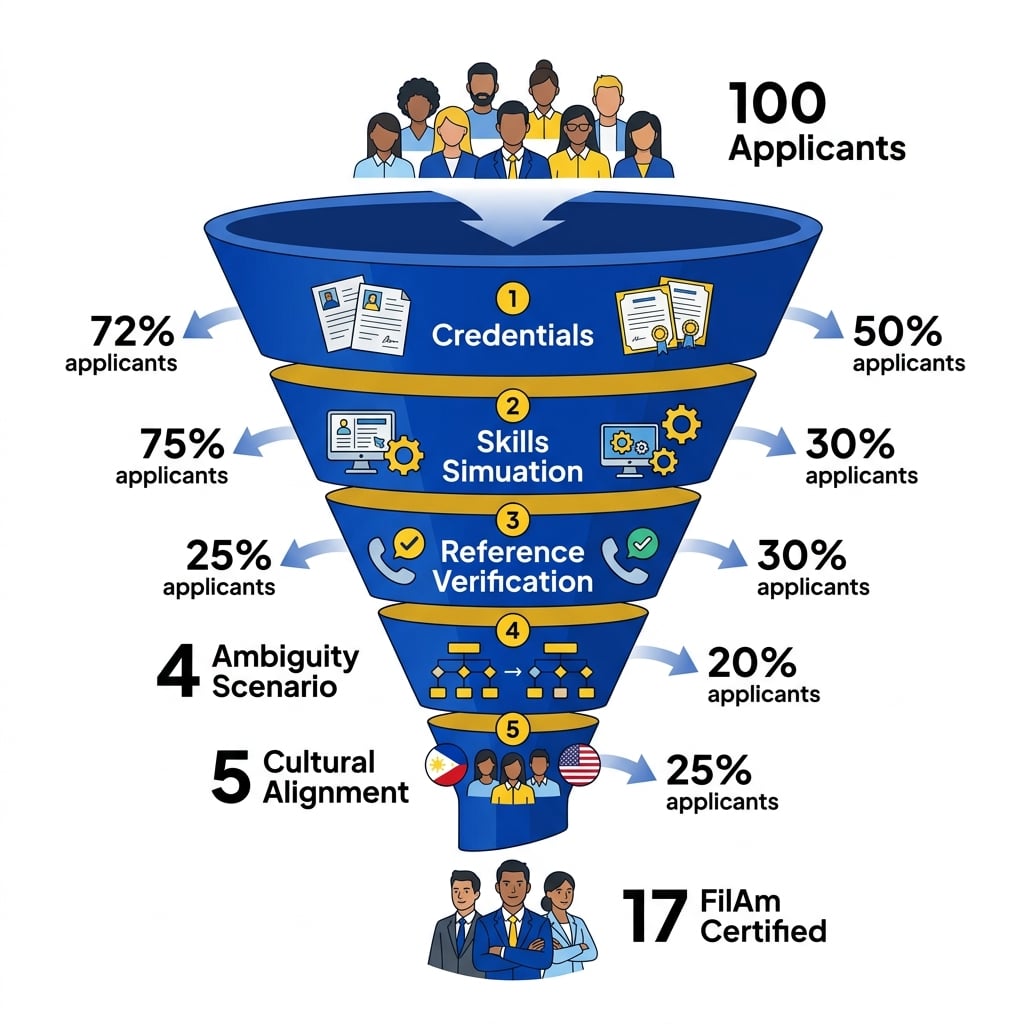
FilAm's Fit Score evaluates five dimensions: English proficiency (oral and written), technical skills (live simulation), reliability history (employment verification), communication style (proactive vs. reactive), and cultural alignment with US startup norms. Only the assessed applicant pool pass all five.
Why FilAm Built a 5-Dimension Fit Score
Most Filipino remote staffing platforms screen on one or two dimensions: English fluency and a resume. That filter produces a shortlist where everyone looks similar on paper and the actual performance variance shows up only after hiring - which is too late.
The Fit Score is built backwards from outcomes. We looked at the FilAm professionals whose engagements lasted 18+ months, generated client expansion (additional roles, higher rates), and showed consistent KPI performance. We mapped what those professionals had in common at the application stage. That mapping became the five dimensions.
The structured assessment process is the natural output: most Filipino professionals are competent in two or three of these dimensions. The ones who score well across all five are rare - and they're the ones who consistently outperform with US clients.
The 5 Fit Score Dimensions
1. English Proficiency - Oral and Written
Two assessments, not one. Most platforms test written English via resume and short answer questions - that's the easier of the two. Oral English under interview pressure is where most candidates separate.
What we test: A 15-minute oral interview where the candidate explains a project, handles a follow-up question, and explains a technical or procedural concept relevant to their role. Written: a 200-word response to a real-world ambiguity scenario in their professional domain. Scoring: clarity, structure, technical vocabulary, and absence of grammatical errors that would create friction in business communication.
Pass threshold: native-near professional fluency in both. Candidates who score "conversational" or below don't reach the shortlist.
2. Technical Skills - Live Work Simulation
Resume claims are unverifiable from 13 time zones away. A live simulation isn't.
For bookkeepers: a reconciliation exercise with deliberate discrepancies, time-tracked. For developers: a coding problem appropriate to their seniority, reviewed by a senior engineer. For executive assistants: a calendar coordination scenario with conflicting priorities. For content writers: a 30-minute writing exercise on a real client brief.
Pass threshold: completes the simulation to a standard equivalent to what a US client would expect from a confident mid-level hire. Time matters - candidates who can't complete the simulation in the allotted window typically also can't handle US-pace work.
3. Reliability History - Verified Employment
FilAm contacts at least two prior employers (or clients, for freelance professionals). Verification covers: dates of engagement, scope of work, reasons for ending the engagement, and any patterns the previous employer/client noticed.
Red flags surfaced at this stage: multiple short engagements ending under unclear circumstances, gaps in employment that the candidate didn't disclose proactively, or feedback patterns suggesting communication or reliability issues.
Pass threshold: at least two verified positive references, with documented track record of completing engagements on terms agreed at start.
4. Communication Style - Proactive vs. Reactive
This dimension is the one that separates the "available person" from the "real operator." Two assessment techniques:
The ambiguity scenario. We provide a project brief with intentionally incomplete information. We measure what happens: does the candidate stall and ask for more direction, or do they make stated assumptions and proceed? Stalling is disqualifying.
The blocker question. "Tell me about a time a project you were responsible for was at risk of missing its deadline. Walk me through what you did before you had guidance from your manager." The answer reveals whether they surface problems early or absorb them silently. We're looking for the former.
5. Cultural Alignment with US Startup Norms
This is the dimension most platforms ignore, and the one that matters most for early-stage US clients. US startup norms differ from corporate norms in specific ways: directness over hierarchy, ROI framing over activity reporting, ownership of outcomes over execution of tasks, async-first communication over meeting-heavy culture.
What we assess: scenario-based interviews on how they'd handle a typical US startup situation - a founder who changes priorities mid-week, a deliverable that needs to ship with imperfect information, a peer whose work overlaps with theirs and creates coordination friction. The answers reveal whether they instinctively operate in startup mode or corporate mode.
Pass threshold: comfort with ambiguity, ownership framing, and async communication as default operating modes.
What "Extreme Ownership" Looks Like in Practice
The Fit Score doesn't just measure capability. It measures the operating mindset that produces consistent ownership behavior over 18+ months of engagement. Three signals of high-ownership Filipino professionals:
- They communicate problems before they're problems. A high-ownership professional surfaces risks 48–72 hours before they would impact deliverables. A passive professional surfaces them after they've already caused a deadline miss.
- They improve what they're given. The first month, they execute the process as documented. The second month, they suggest one improvement. The third month, they ship the improvement and document the change. They're upgrading the system, not just running it.
- They invest in their own learning. The professionals who reach the senior tier within 18 months are the ones who self-direct certification acquisition (QuickBooks, AWS, HubSpot, PMP) without being asked. They're building their own value proposition.
How to Prepare If You're a Filipino Professional Applying to FilAm
- Audit your written and oral English. Record yourself explaining a project. Listen back. Where do you stumble? Practice the specific scenarios from your professional domain until clarity is automatic.
- Document your work samples. Two or three anonymized samples of your best work, organized cleanly and ready to share. Bookkeepers: a sample reconciliation. Writers: published pieces. Developers: a GitHub repo or code sample you can walk through.
- Line up verifiable references. Two prior employers or clients who will respond to FilAm's verification within 5 business days. Confirm with them before you list them.
- Prepare for the ambiguity scenario. Practice making decisions with incomplete information. The simplest framework: "Given what I know, my assumption is X. Based on that assumption, I'll do Y. Here's what would make me reconsider."
- Earn one verified credential before applying. A QuickBooks ProAdvisor, a HubSpot Content Marketing certification, an AWS Cloud Practitioner - any verified credential moves you from "claimed skill" to "verified skill" in the Fit Score evaluation.
Common Questions About the Fit Score
Can I retake the Fit Score if I don't pass the first time?
Yes, after six months. The wait period is intentional - it gives candidates time to address the specific gaps that surfaced in their first assessment. FilAm provides a brief feedback summary after a non-passing result that identifies which dimensions need work.
Is the structured assessment process a fixed quota?
No. It is not a fixed quota. The five-dimension assessment is applied consistently, while the decision depends on the evidence and requirements for each role.
What's the most common reason candidates don't pass?
Communication style - specifically, the difference between proactive and reactive operating modes. Many candidates are technically competent and communicate clearly in English, but their default mode is to execute instructions rather than own outcomes. That gap shows up most clearly in the ambiguity scenario.
Ready to apply? Start at FilAm's application, or read the 2026 salary guide to understand where the rate range sits across roles.
Ready to find your match?
FilAm matches you with vetted Filipino professionals. From $5.85/hr.


