

In this article
Managing Filipino remote professionals works best with outcome-based KPIs, daily async check-ins via Loom, and a clear onboarding document covering role expectations, communication norms, and decision authority. Micromanagement destroys the value proposition - Filipino professionals with extreme ownership deliver better results when given clear goals and trusted to execute.
Why Micromanagement Destroys Remote Work - Especially with Filipino Professionals
Filipino professional culture respects autonomy as a signal of trust and competence. When a US founder over-monitors a Filipino professional, the message received is "I don't trust you to execute." The performance response is predictable: the professional shifts into compliance mode - completing what's asked, doing it adequately, and not expending energy on initiative that wasn't invited.
This is the exact opposite of what most founders want from a remote hire. You hired for ownership. You're managing in a way that prevents ownership. The fix isn't more oversight. It's a different management architecture.
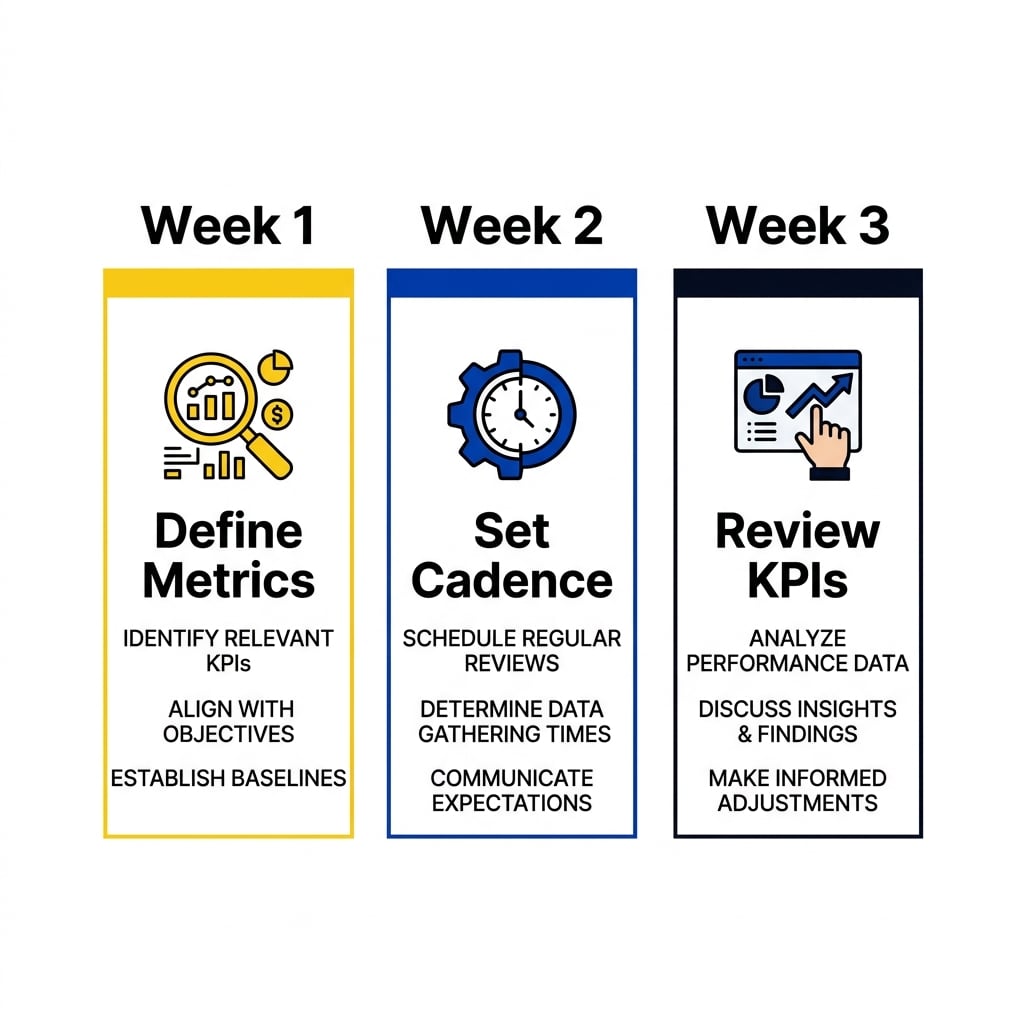
The FilAm Onboarding Framework - KPI-First
Week 1: Define 3 success metrics
Not 10. Not 5. Three. The first week of any FilAm engagement is spent agreeing on three outcomes the professional owns completely. For a content writer: weekly publish count, average organic engagement rate per post, monthly content-driven conversion rate. For a bookkeeper: month-end close date, AR aging accuracy, weekly P&L delivery. Three metrics, written down, agreed by both sides.
Week 2: Establish communication cadence
One daily async update - a 2-minute Loom or written summary - covering what was completed, what's next, and what's blocked. One weekly written KPI review every Monday. One 30-minute live call per week during overlap hours for strategic alignment, not status checking. That's it. No daily standups. No "quick check-ins." Async by default.
Week 3: First KPI review and feedback loop
At the three-week mark, run the first formal KPI review. Compare actual results against the three metrics defined in week 1. Discuss what's working, what isn't, and what needs adjustment. This is the conversation that calibrates the relationship for the next 12 months. Specific feedback, specific behavior changes, specific outcomes.
Async-First Communication - What It Looks Like in Practice
The communication stack that supports autonomous Filipino remote professionals:
- Loom for complex instructions. Anything that needs more than 3 sentences of explanation goes into a Loom video. Replayable, indexable, doesn't require live time. The professional rewinds the parts they need; you keep working.
- Slack for quick questions and acknowledgments. Threaded conversations only - never threadless chaos. One topic per thread. Decisions get summarized at the end of the thread and archived.
- Notion (or your equivalent) for documentation. Every recurring process has a doc. Every decision that affects more than one person gets written down. Documentation reduces the "ask me questions" surface area, which reduces micromanagement pressure.
- A weekly written update template. Same format every week, sent by the professional every Monday before your overlap call. Format: "Last week's outcomes vs. targets. This week's plan. Blockers I need help with." Three sections. No more.
Building Extreme Ownership Into the Relationship
Ownership doesn't happen because you call it ownership. It happens because the structure of the relationship rewards it.
Give the "why," not just the "what." When you brief a project, spend 30 seconds explaining the strategic context - why this matters, what business outcome it serves, what risk it mitigates. Filipino professionals with high ownership use the "why" to make better decisions when ambiguous situations come up. They don't have to ask.
Include the professional in problem-solving, not just execution. When you face a tradeoff or a decision, send it to your professional for input before you decide. Even if you've already made up your mind. Two effects: their input often improves your decision, and they feel like an operator, not a task-doer.
Celebrate ownership behaviors specifically. When your professional flags a risk you hadn't seen, name it: "That catch saved us a week of rework. Thank you." When they propose an improvement, implement it visibly. People do more of what gets recognized.
Trust the gap. When you can't see what someone is doing - because they're 13 hours away and asleep when you're working - the response shouldn't be to monitor harder. It should be to define clearer outcomes and let the work speak. If the outcomes get hit, the gap doesn't matter.
What to Do When Things Go Wrong
Performance issues happen. The way you handle them either reinforces the autonomous relationship or destroys it.
- Address it directly in the weekly KPI review. Not in a separate "I need to talk to you" message that creates anxiety. In the structured review where feedback is normal.
- Reference the specific metric and the specific result. "Last week's target was X. The result was Y. What changed?" Not "I feel like things are off." Specific. Measured. Calm.
- Ask before assuming. Filipino professionals respond well to direct questions. Often there's a context you don't have - a process they didn't know about, a dependency that was unclear, a tool issue. Ask.
- Define what changes by next week. Concrete behavior, concrete outcome. "Next week, the metric needs to be at Z. Here's what I'll do to support: A. Here's what you'll do: B."
- If the pattern continues for two weeks, escalate with FilAm. FilAm's role is to support the relationship. A two-week pattern of missed targets with direct feedback already given is the signal to bring FilAm into the conversation - for a coaching call, a clarification of expectations, or in rare cases, a re-source.
Common Questions About Managing Filipino Remote Professionals
How often should I be in contact with my Filipino remote professional?
One daily async update (written or Loom, 2 minutes max), one weekly written KPI review, and one 30-minute live call per week. That's the standard cadence. More frequent contact than this typically signals an underlying trust or clarity issue that more meetings won't solve.
What if my professional doesn't ask enough questions?
Often a signal that they don't feel safe asking, or that the documentation gap is forcing them to guess. Two fixes: explicitly invite questions in your weekly review ("What needs clarification this week?"), and improve the documentation they're working from. If they still don't ask after two weeks, it may indicate they're producing work without confidence - surface that directly.
How do I handle a Filipino professional who works very long hours unprompted?
Address it directly and quickly. Long unprompted hours often indicate over-scope or under-skill - both of which need a conversation, not silent acceptance. The healthy operating mode is consistent quality output within agreed hours. If they're consistently working over, either the scope is wrong or the role mapping needs revisiting.
For the full hiring process, see how FilAm matches, or read the why US startups hire Filipino professionals rationale.
Ready to find your match?
FilAm matches you with vetted Filipino professionals. From $5.85/hr.


