

In this article
The Structural Advantage Nobody Talks About
When most US founders think about hiring Filipino professionals, the conversation starts and ends with cost. That framing is not just reductive - it actively costs you. It means you're optimizing for the wrong variable, attracting the wrong candidates, and setting the wrong expectations from day one.
The Filipino professionals who consistently outperform in US remote roles aren't winning on price. They're winning on alignment - cultural, professional, and operational alignment that took decades to develop and isn't available anywhere else at the same depth.
Let's break down exactly why.
American-Influenced Education, Built-In
The Philippines spent nearly 50 years under American administration - long enough for the entire educational infrastructure to be modeled on US systems. English isn't a second language learned for business purposes; it's a co-official language, the medium of instruction from elementary through graduate school, and the default language of professional communication in every major industry.
That matters more than it sounds. When you hire someone whose mental models, technical vocabulary, and professional norms were built inside the same framework as yours, you eliminate an entire class of friction. No translating expectations. No recalibrating tone. No explaining why a weekly update should proactively include blockers, not just accomplishments.
A Filipino SDR who grew up watching American business culture, trained in English, and worked inside Manila's tech-forward startup ecosystem is not a foreign hire in the way that phrase usually implies. They're a remote hire. There's a meaningful difference.
Tech-Nativeness That Runs Deep
The Philippines has one of the highest social media penetration rates in the world. Filipino professionals don't learn tools because HR mandated it - they grew up on them. Notion, Slack, Loom, HubSpot, Figma, Asana, ChatGPT: these are native environments, not onboarding hurdles.
In roles where tool fluency translates directly to output velocity - digital marketing, content operations, customer success, business development - this is a genuine performance edge. The best Filipino specialists come in already knowing how to structure a Notion SOP, how to use Slack threads to eliminate meeting overhead, and how to push async Loom updates instead of scheduling a call.
That's not a coincidence. It's the byproduct of a digitally connected, English-speaking professional class that has been building remote-work muscle since before the rest of the world made it fashionable.

Work Ethic Forged by Reality
The best Filipino professionals carry a specific kind of hunger that's hard to manufacture. The Philippine economy creates people who understand that career outcomes are earned, not entitled. Competition for top roles is fierce. The best companies - Accenture, Google, Shopify, major US agencies - are attracting talent from a nation of 115 million. The ones who rise aren't passive.
What you get from a vetted, senior Filipino professional is someone who has already demonstrated they can compete, that they can push through friction, and that their career trajectory is a product of consistent performance. That shapes how they show up for you.
In ops roles, they build systems before you ask. In digital marketing roles, they bring you a performance analysis you didn't commission. In SDR roles, they hit their numbers and then ask what else needs moving. This isn't universal - it's the result of genuine vetting - but it's reproducible when you hire correctly.
What Extreme Ownership Actually Looks Like in Practice
Ownership is a word that gets thrown around until it loses meaning. Let me make it concrete with roles we staff every week.
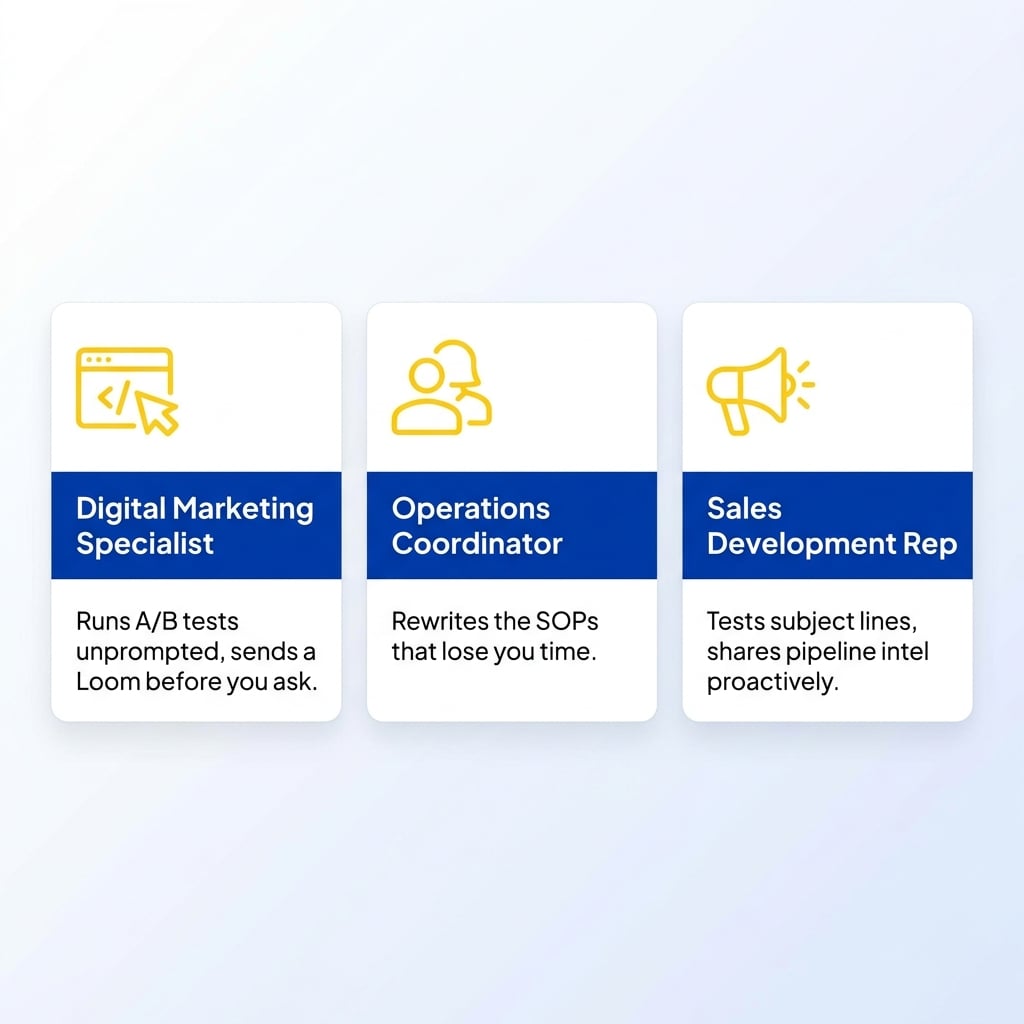
Digital Marketing Specialists: A high-performing Filipino marketer doesn't wait for campaign results to surface in a weekly report. They're in the dashboard daily, flagging anomalies, running A/B tests on their own initiative, and sending you a Loom breakdown before you've thought to ask. They treat your ROAS like it's their own business metric.
Operations Coordinators: Where a passive hire documents what exists, an ownership-oriented ops professional identifies what's missing. They don't just run your SOPs - they rewrite the ones that are losing you time. They implement tools. They close loops before they become fires.
Sales Development Representatives: The best SDRs we've placed don't just execute sequences. They A/B test subject lines, qualify faster by reading room tone in async messages, and proactively share pipeline intel in Slack without prompting. They're building the function, not just filling a seat.
The "Yes-Man" Trap and How to Avoid It
There's a legitimate concern that deserves a direct answer: the stereotype of the overly agreeable remote hire who says yes to everything, delivers exactly what was asked, and flags nothing proactively. That profile exists. It's not exclusive to Filipino professionals - it's the output of poor hiring criteria applied to any market.
When you hire for English fluency and availability, you get availability. When you hire for extreme ownership, structured problem-solving, and proactive communication - and you vet for those things specifically - you get a completely different person. The yes-man problem is a sourcing and vetting failure, not a cultural one.
Our vetting process is specifically built to filter for the latter. Every candidate we advance is assessed on how they handle ambiguity, how they communicate blockers, and whether they take initiative or wait for instructions. It's not perfect - no hiring process is - but it's targeted.
The Bottom Line
Filipino professionals don't win in US remote roles because they're affordable. The ones who consistently outperform win because they're aligned - linguistically, culturally, technologically, and professionally - with how US businesses actually operate.
The cost advantage is real and it compounds over time. But it's the supporting argument, not the lead one. When you hire a vetted Filipino specialist through a process designed to surface ownership and not just output, you're not making a budget decision. You're making a leverage decision.
We don't recruit Filipinos because they're affordable. We recruit them because the best ones operate like partners, not vendors.
Ready to find your match?
FilAm matches you with vetted Filipino professionals. From $5.85/hr.


