

In this article
Extreme ownership in a remote team means every person owns their outcomes completely - not just their tasks. They flag blockers before they become delays, propose solutions before they ask for decisions, and treat team goals as personal commitments. You can't coach this in after the hire. You have to screen for it, structure for it, and reinforce it from day one.
What Is Extreme Ownership and Why Remote Teams Need It More
Extreme ownership is the operating principle that every person on the team is responsible for their results - not just their effort, not just their hours, not just what they were explicitly told to do. They own the outcome.
In a co-located team, accountability is ambient. You see problems surfacing. You pick up on tone in the hallway. You know who's stuck because you walk past their desk. In a remote team, none of that exists. If someone isn't proactively communicating, you don't find out until a deadline slips.
This makes ownership culture more important in remote teams, not less. The gap between a high-ownership remote professional and a passive one is measured in weeks of lost momentum per quarter.
The Accountability System That Works Across Time Zones
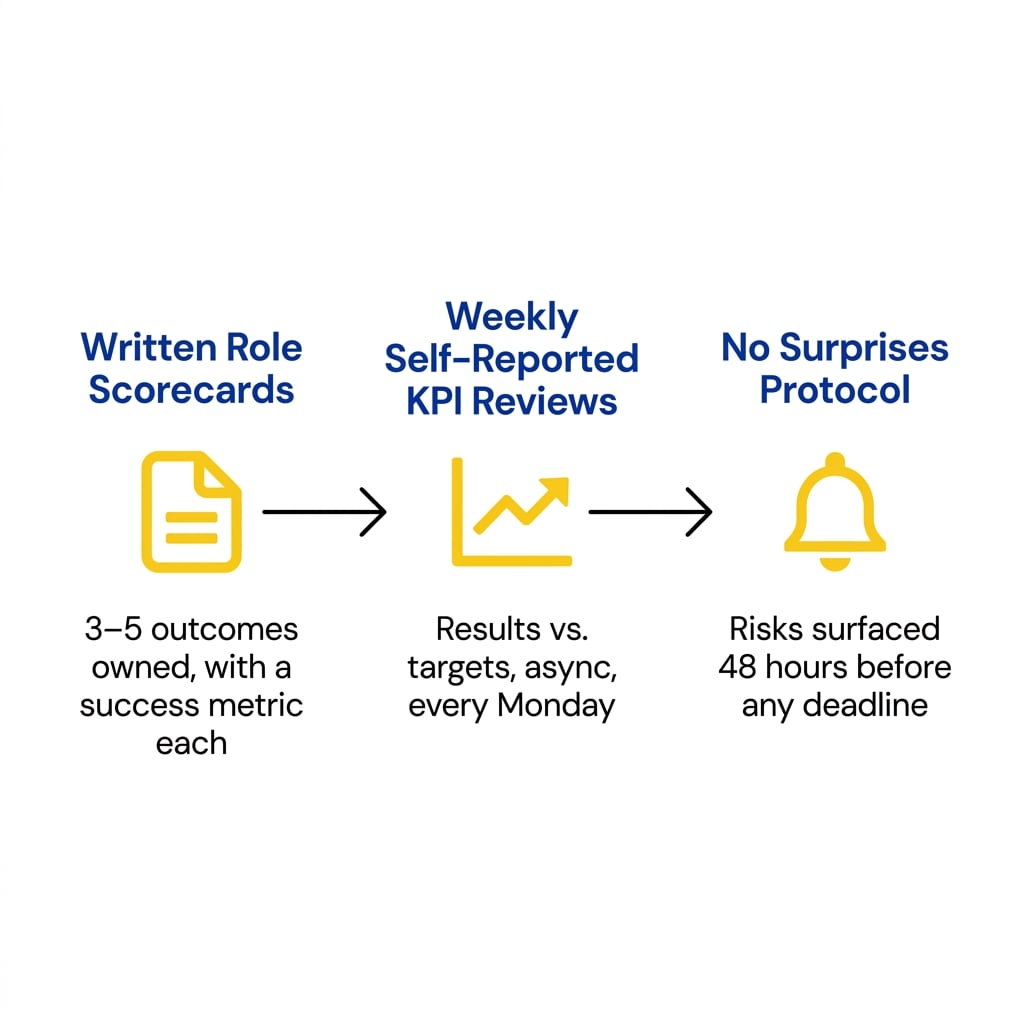
Accountability doesn't require surveillance. It requires structure. Here's the three-part system that works across 12-hour time zone gaps without micromanagement.
Written Role Scorecards
Every role gets a one-page scorecard before day one: three to five outcomes they own (not tasks), the metric that signals success for each, and the cadence for reporting. This isn't a job description - it's a contract for results.
A content writer's scorecard might read: "5 SEO-optimized blog posts per week, each 1,500+ words, targeting approved keywords, published in CMS by Friday 5pm PHT." That's measurable, self-reportable, and leaves no ambiguity about what success looks like.
Weekly Self-Reported KPI Reviews
Every Monday, each team member submits a KPI update: last week's results vs. targets, this week's plan, and any blockers. No meeting required - it's async, in Notion or a shared doc.
The self-reporting mechanism is critical. When people report their own numbers, they can't separate themselves from the outcome. There's nowhere to hide behind a busy week. The scorecard is the standard; the weekly update is the reckoning.
The No Surprises Protocol
One rule, strictly enforced: no surprises at deadline. If something is at risk - a blocker, a dependency that's late, a scope issue - it gets surfaced at least 48 hours before the deadline. Not after. Not during the handoff. Before.
This protocol changes behavior fast. Once the team knows that surfacing a risk early is rewarded, and that a missed deadline without warning is a serious breach, the communication patterns shift within weeks.
What Extreme Ownership Looks Like in Practice: 3 Scenarios
Scenario 1 - The developer who finds the bug before you do. A high-ownership developer doesn't just write the feature. They test edge cases you didn't specify, document what they built, and flag the one dependency that could cause a regression in the module they touched last sprint. You find out about the risk from them, not from a user report.
Scenario 2 - The EA who fixes the problem before you notice. Your EA notices a double-booking three days out. They don't wait for you to flag it. They reshuffle both meetings, send rescheduling messages in your name, and send you a Loom update showing what changed and why. You didn't ask. The problem doesn't exist by the time you'd have seen it.
Scenario 3 - The content writer who flags the strategy gap. You briefed a blog post on "best project management tools." Your content writer comes back not just with the draft, but with a note: three competitor posts outrank on this keyword and two have updated schemas that yours won't beat without a structural change. They propose a 200-word addition and ask for approval. They already drafted it.
In each case, the professional isn't waiting for direction. They're treating your outcomes as their own problem to solve.
How FilAm Screens for Accountability During Vetting
Ownership is hard to fake in a structured assessment. FilAm uses two screening mechanisms specifically designed to surface it.
First, the ambiguity scenario: candidates receive a task brief with intentionally incomplete information. The instruction is to complete it. The assessment isn't the output - it's how they handle the gaps. Do they state their assumptions and proceed? Do they ask one clarifying question and then commit? Or do they stall entirely until given more direction? Stalling is disqualifying.
Second, the blocker question: "Tell me about a time a project you were responsible for was at risk of missing its deadline. Walk me through exactly what you did." The answer reveals whether they surface problems or absorb them. Whether they communicate or cover up. Whether they treat your timeline as their responsibility or yours.
Candidates who pass both make it to the shortlist. By the time you're meeting a FilAm candidate, you're talking to someone who has already demonstrated ownership under test conditions.

Common Questions About Remote Team Culture
Can you build a strong team culture with people you've never met in person?
Yes. Culture isn't geography - it's shared standards, reinforced daily. A team that has a clear scorecard, a no-surprises protocol, and consistent rituals (weekly KPI updates, async retrospectives) builds shared norms faster than a co-located team without structure.
What if a team member isn't improving even with the structure?
Address it directly in the weekly KPI review. Give specific feedback with the scorecard as the reference: "Last week's target was X, the result was Y. What changed, and what's your plan to close the gap next week?" If the pattern doesn't shift within two weeks of direct feedback, it's a hiring miss, not a management problem. Escalate with FilAm.
How do you handle time zone gaps in accountability systems?
Design the system to be async by default. The scorecard, KPI updates, and no-surprises protocol all work without real-time interaction. The only synchronous touchpoint that matters is a 30-minute weekly review call - which most teams schedule at the edge of their overlap window.
Is this approach only for senior hires?
No. Junior hires benefit from the structure most. A clear scorecard and self-reporting cadence removes ambiguity that trips up early-career professionals in any remote context. The framework scales up, not down - senior hires often improve it on their own once they see the system.
Key Takeaways
- Remote accountability requires structure, not surveillance - scorecards and self-reporting replace the ambient accountability of co-located teams
- The no-surprises protocol is the single highest-leverage behavior change you can implement this week
- Ownership can't be coached in after the hire - it must be screened for during vetting
- FilAm's ambiguity scenario and blocker question filter for ownership before candidates reach your shortlist
- The weekly KPI review is your main management lever - async, 10 minutes, and tells you everything you need to know
Looking to hire professionals already screened for ownership? Browse open roles on FilAm or apply as a talent professional.
Ready to find your match?
FilAm matches you with vetted Filipino professionals. From $5.85/hr.


